 Skip to main content


Proudly Serving Sacramento & Nearby Areas




Trusted by 3021+ Customers
Mini Split for a Garage: Sizing and Common Questions
Sacramento’s Trusted Home Comfort Experts


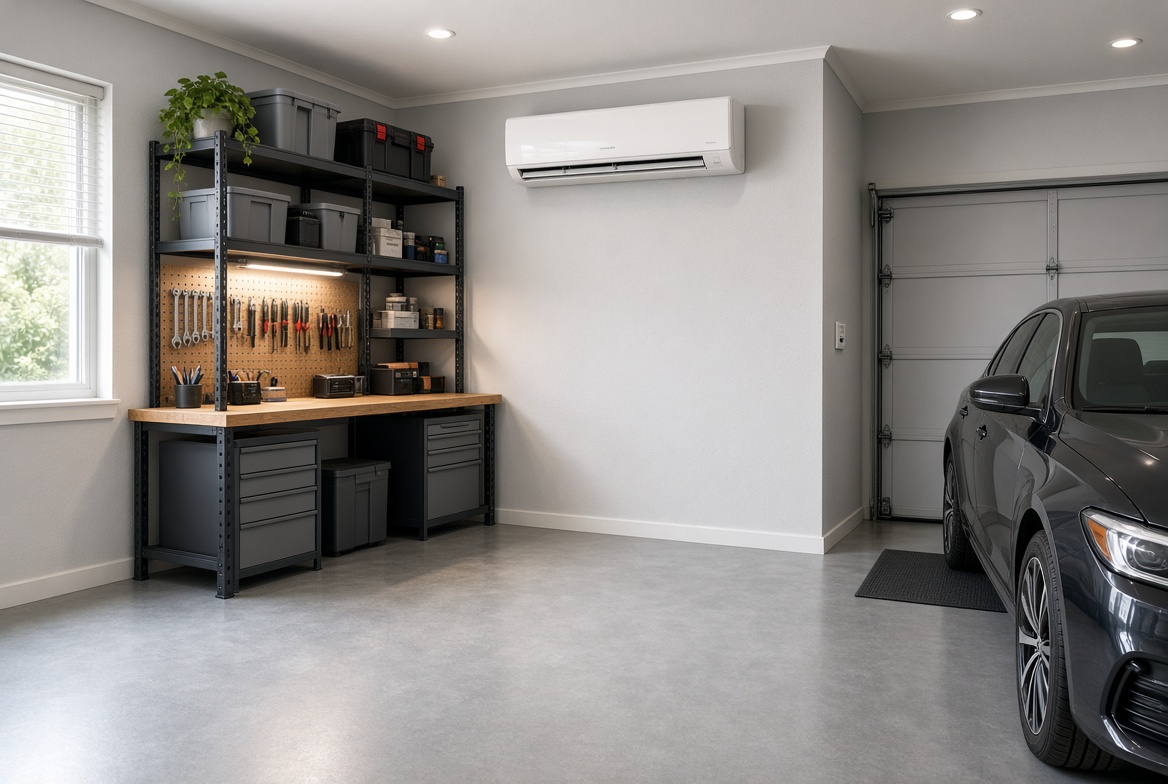
Most people call us about a garage in July. The car sits out front because the bay is full of tools, the space hits an oven-like temperature by 2 p.m., and the plan is simple: put a small unit on the wall and finally use the room.
That plan usually works. What catches homeowners off guard is that in California, a mini split in a garage is not always treated as a small comfort upgrade. Depending on the capacity you install, the state energy code may treat that garage as conditioned space, which changes what the permit requires.
At Atticman Heating and Air Conditioning, Insulation, we install a lot of ductless mini split systems in Sacramento, and the sizing question is only half of what people actually need answered. Below is what we’ve found matters most, along with the code and program details that rarely show up in generic sizing charts.
Why a Mini Split Is the Only Compliant Way to Cool an Attached Garage
Direct answer: you cannot legally run supply or return ducts from your home’s HVAC system into an attached garage. A dedicated, garage-only system is the compliant path.
The residential code language is specific. Under IRC/CRC Section R302.5.2, ducts in the garage and ducts that pass through the wall or ceiling separating the dwelling from the garage must be built from a minimum 26 gauge sheet steel or other approved material, and they cannot have any openings into the garage.
The mechanical code adds a matching rule on the return side, with one exception that explains why ductless works here. Under IMC 601.5, Exception 2, a forced air system that serves only the garage is allowed to pull return air from the garage. A mini split qualifies because it serves that one space and nothing else.
There’s a health reason behind the rule. Allison A. Bailes III, PhD, a physicist and building science consultant who founded Energy Vanguard, has written that homes with an attached garage tend to carry higher carbon monoxide levels in their indoor air than homes without one. Writing in GreenBuildingAdvisor about garage cooling, he made the point plainly: if you are going to condition a garage, it needs its own separate system rather than a branch off the house.
That’s the honest case for ductless here. It isn’t a preference. It’s the design that keeps garage air where it belongs.
The Atticman Garage Load Check: Four Things That Move the Number More Than Square Footage
A 400 square foot bedroom and a 400 square foot garage are not the same load. We use four checks when we walk a garage, and they explain why online charts miss so often.
- Door. The garage door is usually the largest uninsulated surface in the room and the biggest single air leak. A west-facing door taking afternoon sun changes the calculation more than the floor area does.
- Deck. What sits above. An uninsulated roof deck or attic over the garage adds radiant gain all afternoon.
- Depth. Ceiling height and total volume, not square footage. Storage lofts and vaulted framing hold more air and more stratified heat.
- Duty. What happens in the space. A hot car parked inside, a welder, a compressor, an EV charger, or a home gym all add internal gain that a bedroom never sees.
Run those four and you’ll usually see why a garage needs meaningfully more capacity than the same footprint indoors.
What Size Mini Split Do I Need for a 2 Car Garage?
Direct answer: there’s no honest square-footage answer. The governing number comes from an ACCA Manual J load calculation for that specific garage.
We’d rather be straight with you than publish a chart that looks authoritative and isn’t. Here’s how the common methods actually stack up.
| Sizing method | What it’s based on | Where it breaks down in a garage | Standing |
| ~20 BTU per sq ft | General room sizing guidance for insulated interior rooms | Assumes an insulated shell, normal ceiling height, low internal gain | Rule of thumb, not a published standard |
| 25 to 30 BTU per sq ft | Industry adjustment for garages | Ignores door orientation, ceiling volume, and shop equipment | Rule of thumb, not code |
| ACCA Manual J, 8th Edition | ANSI-recognized residential load calculation, room by room | Accounts for the garage partition wall as an adjustable default | The recognized standard |
| ACCA Manual S, 3rd Edition (released 2024) | Equipment selection once the load is known | Sizing tolerances were expanded for variable capacity heat pumps | The recognized standard |
Can a Mini Split Be Too Big for a Garage?
Yes, and it’s a common miss. ACCA’s position, as reported by ACHR News, is that Manual S sets the minimum excess capacity at 15 percent, meaning equipment sized at 115 percent of the total cooling load. That ceiling exists to limit short cycling, which shortens equipment life.
An oversized head in a garage runs in short bursts, pulls less moisture, and wears harder. Bigger is not safer.
Does an Uninsulated Garage Need a Bigger Unit?
Usually yes, and that leads to a better question: would you rather buy capacity or buy shell?
We often find it works out better to improve the envelope first and then size the equipment to a smaller load. If the roof deck above the garage is bare and the door has no insulation, a walkthrough of what your garage and attic insulation actually looks like is worth doing before anyone quotes tonnage. We currently offer a complimentary insulation inspection, which is the cheapest way to answer this before committing.
Does Putting a Mini Split in My Garage Make It Conditioned Space in California?
Direct answer: it can, and the threshold is lower than most homeowners expect.
Title 24, Part 6, Section 100.1 defines directly conditioned space as an enclosed space with mechanical heating capacity above 10 Btu/hr per square foot, or mechanical cooling capacity above 5 Btu/hr per square foot, unless the system is designed for a process space.
Do the math on a typical two-car garage. A 400 square foot garage with a 12,000 BTU head works out to 30 Btu/hr per square foot. That’s three times the heating threshold and six times the cooling threshold.
Title 24 then defines newly conditioned space as any space converted from unconditioned to directly or indirectly conditioned, and newly conditioned space has to meet the requirements for an addition under Section 150.2(a) for residential buildings.
The California Energy Commission’s 2025 Energy Code FAQ names this scenario directly. It lists both attached and detached garage conversions to conditioned floor area as conversions that comply as additions, and it clarifies that existing walls around newly conditioned space are treated as new for energy code purposes, since those walls now form the building envelope.
That’s not a reason to skip the project. It’s a reason to have the conversation before the permit is pulled, not after. Our team can walk your garage and tell you where the capacity you want lands relative to those thresholds. Call 916-299-7558 or book online and we’ll take a look.
Do I Need a Permit and HERS Testing for a Garage Mini Split?
Direct answer: a new mini split is permitted mechanical work in California, and refrigerant charge verification by a HERS rater applies to mini split systems.
Title 24’s HERS measure list includes refrigerant charge for split systems, packaged units, and mini splits. A summary of the 2025 code changes notes that for altered space conditioning systems, refrigerant charge verification is required for heat pumps in all climate zones, and for air conditioners in Climate Zones 2 and 8 through 15. Sacramento sits inside that group either way.
The 2025 Energy Code applies to permit applications filed on or after January 1, 2026. The California Energy Commission describes the update as notable for encouraging heat pumps for space and water heating.
We understand the paperwork feels like friction. In practice, the HERS verification is the only independent proof that your system was charged correctly. An undercharged mini split still blows air. It just never delivers the capacity you paid for.
Permit fees vary by jurisdiction across Sacramento, Placer, El Dorado, Yolo, and San Joaquin counties, so we’d suggest confirming current amounts with your local building department rather than relying on a figure online.
Can a Mini Split Heat a Garage in Winter?
Direct answer: yes. A mini split is a heat pump, and Sacramento Valley winter design conditions sit comfortably inside the published operating range of modern inverter equipment.
County-level references place Sacramento County near a 99 percent winter heating design temperature around 29°F. Treat that as approximate. The exact station value used for your project comes from the Manual J calculation your contractor runs.
Manufacturer data shows why “12,000 BTU” isn’t a single number. One Daikin single-zone submittal sheet publishes rated heating capacity of 13,400 Btu/hr at 47°F outdoor, dropping to 8,800 Btu/hr at 17°F, with a heating operating range down to -13°F. Capacity falls as it gets colder, and the published table is where you check it.
One detail worth asking about: that same sheet lists a standard cooling operating range of 50°F to 115°F, extending to -4°F only with field settings and a wind baffle. If you plan to cool a workshop on a cold but sunny day, mention it during the estimate.
For efficiency, AHRI notes the national minimum for split system heat pumps moved to 14.3 SEER2 and 7.5 HSPF2, enforced by date of manufacture. Anything quoted new will meet or exceed that.
Do I Need a Backup Heater in a Sacramento Garage?
For most garages here, no. Around Placerville, Auburn, and the higher foothill areas, it’s worth reviewing the equipment’s published low-temperature capacity against your actual load rather than assuming.
Will a Mini Split Keep a Garage Cool When It Hits 105 Outside?
Direct answer: yes, if it was sized to the real load and the outdoor unit can breathe.
Sacramento averages roughly 23 days a year at 100°F or hotter. The city set a record of 45 such days in 2024 and recorded an all-time high of 116°F in September 2022. That’s the condition sizing has to survive, and it’s why we treat cooling, not heating, as the harder problem in this service area.
Placement matters more than people expect. Rated capacity is measured at 95°F entering air. An outdoor unit boxed into a tight, unventilated side yard sees hotter air than that, and capacity follows.
Are There Rebates for a Garage Mini Split in Sacramento?
Direct answer: generally no, if the mini split serves only the garage.
SMUD’s heating and cooling rebate page carries a footnote stating that mini splits must serve the entire home and meet the program’s minimum HVAC system requirements. A garage-only head typically won’t clear that bar on its own. A garage head added as part of a whole-home ductless conversion is a different conversation, and one worth having.
SMUD raised its residential heat pump rebate levels in February 2026, citing the expiration of federal credits, with amounts listed up to $3,000 for gas-to-electric heat pump HVAC conversions and $1,000 for electric-to-electric upgrades. Program requirements include a variable stage compressor or a two stage compressor at 15.2 SEER2 minimum, a Title 24 pass documented via HERS CF3R, and a connected Wi-Fi thermostat.
We’re an authorized SMUD contractor and were recognized as a SMUD Top Contractor Award winner in 2025, so we can tell you where a specific project actually lands before you count on anything. Program rules do change, so confirm current terms with SMUD or with us.
Is There Still a Federal Tax Credit for a Mini Split?
No. Section 25C, the Energy Efficient Home Improvement Credit, applied only to equipment placed in service on or before December 31, 2025. It was terminated by the One Big Beautiful Bill Act, Public Law 119-21, signed July 4, 2025, for anything placed in service after that date. Reporting on the change notes the IRS uses the placed-in-service date, so equipment purchased in 2025 but installed later doesn’t qualify.
Older articles still tell readers to claim 30 percent are out of date. For your own situation, please check with a tax professional.
Frequently Asked Questions
Does a garage mini split need its own electrical circuit? Yes. A mini split needs a dedicated circuit and a disconnect at the outdoor unit, and older panels sometimes lack the capacity. One code note worth flagging: the 2025 California Electrical Code adopts the 2023 NEC, and NEC 210.8(F) requires GFCI protection for outdoor outlets at dwellings, with an exception for listed HVAC equipment that the code text states expires September 1, 2026. Ask your contractor what your local building department is currently enforcing.
Does a mini split in a garage need to be a certain height off the floor? California Building Code Section 406.2.9 requires equipment with an ignition source in a private garage to be elevated so the ignition source sits at least 18 inches above the floor. A wall-mounted head at seven feet clears this without thought. A floor-mounted console head does not, which is one reason we don’t recommend picking equipment style from a product page. Equipment in garages also has to be protected from vehicle contact.
Can a mini split be installed in a detached garage? Yes, and it’s often simpler because the fire separation and duct restrictions between the dwelling and garage don’t apply the same way. The line set run, condensate route, and circuit from the main panel become the design questions instead.
Where does the condensate from a garage mini split go? That’s a design decision made during the estimate, since most garages have no floor drain. Depending on the layout, we look at gravity drainage to an exterior point or a condensate pump. It should be planned before install day, not improvised.
What refrigerant will my new mini split use? Most systems quoted now use an A2L refrigerant such as R-454B or R-32, following EPA’s 700 GWP limit for residential air conditioning and heat pumps. In a final rule published May 26, 2026, EPA removed the installation deadline for systems whose specified components were manufactured or imported before January 1, 2025, so some legacy R-410A equipment can still be installed. It’s a fair question to ask on any quote.
Does refrigerant type affect where the indoor head can go? It can be in small rooms. UL Solutions explains that UL 60335-2-40 ties refrigerant charge limits to the minimum occupied volume of the room, with a safety factor of four applied against the lower flammability limit. Most garages are large enough that this isn’t a constraint, but a small single-bay garage or a low-mounted head changes the math. The equipment listing and the manufacturer’s installation manual govern, and your installer checks the minimum room area table.
How much maintenance does a garage mini split need if I use the space as a shop? More than a bedroom head. Sawdust, grinding debris, and general garage dust load the indoor coil and filters faster. If you’re running a woodshop, plan on a shorter filter interval and regular coil cleaning to protect capacity.
Get a Straight Answer on Your Garage Before You Buy Equipment
We’ve walked enough garages across Sacramento, Elk Grove, Roseville, Folsom, Rocklin, Citrus Heights, Rancho Cordova, and the surrounding foothill towns to know that the sizing number is rarely the hard part. The shell, the door, the permit path, and whether your capacity crosses the Title 24 threshold are what decide whether you’re happy with the result three summers from now.
Atticman Heating and Air Conditioning, Insulation holds California contractor license #1046762, our technicians are NATE-certified, and our installations carry a 10-year installation equipment warranty. We offer no-charge diagnostics so you understand what you’re dealing with before committing to anything.
Call 916-299-7558 or book online, and we’ll run the load calculation, check the envelope, and give you the real answer for your garage. We’re open Monday through Saturday, 7:30 a.m. to 6 p.m., with 24/7 live answering.
Recent Posts
AC Unit Freezing Up in Summer? Questions People Ask
AC Not Keeping Up With Heat? What Our Service Calls Show

Sacramento HVAC Leader Mario Lopez Named to 40 Trades Under 40 Class of 2026
Questions or Concerns?
Fill out this form and our team will get back to you as soon as possible.
THE TRUSTED TEAM THAT PUTS YOUR HOME FIRST
Get expert service for your home today!


Homegrown service you can trust, built by a local.
Proudly serving the neighborhood we grew up in.